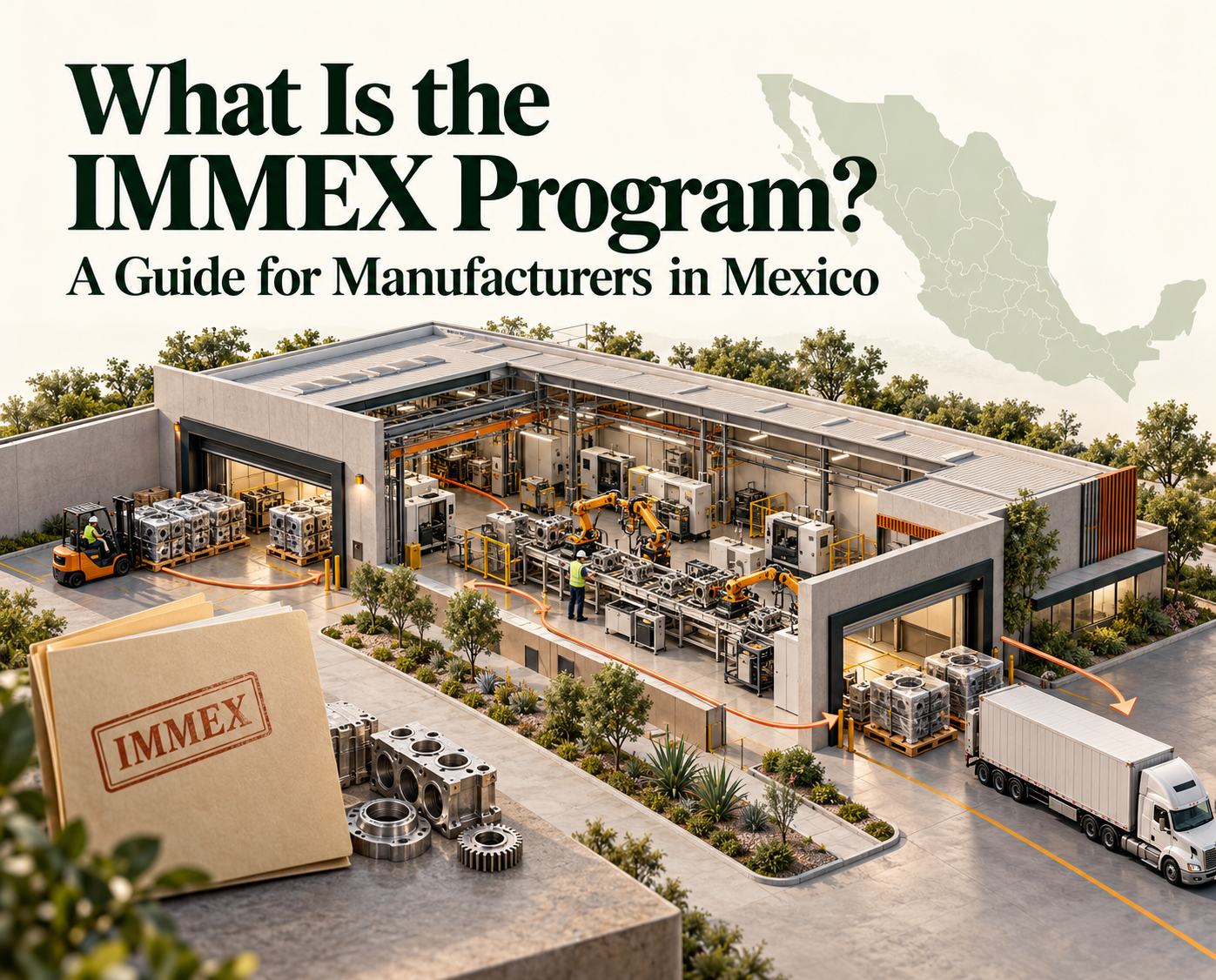
What Is the IMMEX Program? A Guide for Manufacturers in Mexico
Mexico has become a genuinely significant player in global exports. Manufacturers come from all over the world to build products that can be shipped to many different places. Nearshoring, in particular, has pushed more foreign manufacturers to work south of the border, many of them eyeing the IMMEX program early. It’s currently ubiquitous. In fact, as of February 2026, Mexico had 6,013 active IMMEX establishments. Those businesses employ more than 3 million people.
IMMEX can cut costs while freeing up capital, but it does carry strict customs compliance rules, some of which have proven genuinely challenging for businesses to meet. In this article, we explain what IMMEX is, how it works, who qualifies, and what it takes to remain compliant.
What Is the IMMEX Program?
The IMMEX program is a Mexican government program. It exists for companies that produce or otherwise service goods that are meant for export. It stands for Industria Manufacturera, Maquiladora y de Servicios de Exportación, which translates to the Manufacturing, Maquiladora, and Export Services Industry.
Once companies have been approved for the IMMEX program, they can temporarily import materials, components, packaging, and machinery without worrying about import duties or VAT at entry. This remains the case for as long as the goods are used in the context of exports. The Secretaría de Economía (SE) is in charge of the program, while Mexico’s tax authority, along with the customs agencies, oversees the tax enforcement aspect of the arrangement.
As one might imagine, this has become a genuinely important element of the Mexican economy. In fact, a 2026 industry forum revealed that IMMEX companies account for more than 62 percent of Mexican exports.
A Brief History of IMMEX
IMMEX is effectively the brainchild of Mexico’s maquiladora model. This system was mostly used as far back as the 1960s at border factories, which would assemble parts for export to the United States. Things shifted in the early 21st century when Mexico combined that program with an older PITEX program. This resulted in the IMMEX decree, which still governs the program today.
How the IMMEX Program Works
The IMMEX program follows a relatively simple cycle. Companies import goods, which are then transformed or assembled in Mexico. From there, they are exported as a finished product. These items will generally only stay in Mexico for a short period of time. For this reason, they are not treated as traditional imports. Import duties and VAT are deferred at the border rather than being paid up front.
Timing plays a large part in the eventual savings. IMMEX affects when taxes are paid. This allows businesses to hang on to more cash during production. USMCA does add a bit of a wrinkle in the form of duties that could apply to non-North American inputs.
Time Limits on Temporary Imports
Naturally, the system only works if temporary really means temporary. In this particular case, materials can remain in the country for 18 months or less. Machinery is given an exemption and can remain for the duration of the program. If goods are to exceed this time frame, they must be exported, returned, or moved into a definitive import regime, which will require duties and taxes to be paid in full.
Selling in the Mexican Market
It is possible to sell goods within Mexico as part of the IMMEX program. To do this, goods must first be changed to a definitive import regime, which will result in duties and taxes getting paid.
Types of IMMEX Programs
There are five active modalities present in the IMMEX decree. All of them exist to fit a specific business structure.
Industrial
Arguably, the industrial framework is the simplest. One company runs an industrial process that transforms goods destined for export.
Services
This is relevant to businesses that provide a service related to exported goods, for example, repairing, sorting, testing, and packaging.
Shelter
In sheltering scenarios, companies supply technology and production materials. A Mexican shelter provider then holds the IMMEX program and administers its production. This setup allows new entrants to begin production quickly, even before they’ve registered their own legal entity.
Holding
Holding companies can place their own manufacturing, along with one or more subsidiaries, under a single program. This makes the entire system easier to manage for groups that are responsible for multiple plants.
Outsourcing
Companies that are certified but lack their own production facilities are able to manufacture through registered third parties. The program holder remains responsible for the goods themselves, and they also must maintain compliance standards.
Key Benefits of the IMMEX Program for Manufacturers
We’ve already described some of the benefits tangentially, but here we’ll take a closer look at exactly what this means for businesses interested in operating in Mexico from a manufacturing perspective.
Deferred Import Duties
As mentioned earlier, materials, components, and packaging can enter Mexico without required import duties. This both makes production more affordable and helps with cash flow management.
VAT and IEPS Credit
Typically, Mexico charges 16% VAT on most imports. With IVA/IEPS certification from SAT, imports are not held to that. Depending on the size of the operation, this credit alone can be worth millions of dollars. In certain cases, this exemption is why companies will apply for IMMEX in the first place.
Machinery and Equipment
As mentioned in an earlier heading, machinery and equipment can remain in the country for the duration of the program.
How to Apply for an IMMEX Program
The application itself moves fairly quickly. Most of the work happens in the preparation, so a clean file makes a big difference.
- Set up your structure. Form a Mexican legal entity, or sign with a shelter provider that already holds a program.
- Register with SAT. Obtain an RFC and e.firma, and make sure the company is current on its tax filings.
- Secure your facility. Lease or buy the site and keep documents that prove legal possession.
- Prepare your documents. Describe the production process, list tariff classifications, and gather contracts or purchase orders.
- File with the SE. Submit the application electronically through VUCEM, Mexico’s foreign trade single window.
- Wait for the resolution. The SE is expected to issue a resolution within 10 business days and may verify the facility.
- Apply for VAT certification. Once approved, request IVA/IEPS certification from SAT to unlock the VAT credit.
Delays usually come from incomplete files. Mismatched addresses, vague process descriptions, and wrong tariff codes are common reasons for rejection.
Conclusion
The IMMEX program remains one of Mexico’s most valuable tools for export manufacturers. Through lower upfront costs that free up working capital, the program has done much to support the growth of nearshoring.
To truly and completely experience the benefits of IMMEX, disciplined customs compliance is required.
Vector Trade Office helps manufacturers keep IMMEX freight moving between the United States and Mexico. As a cross-border logistics and 4PL partner, we coordinate carriers, customs brokers, and documentation so shipments clear without surprises. Contact Vector Trade Office to learn how we can support your IMMEX operation.