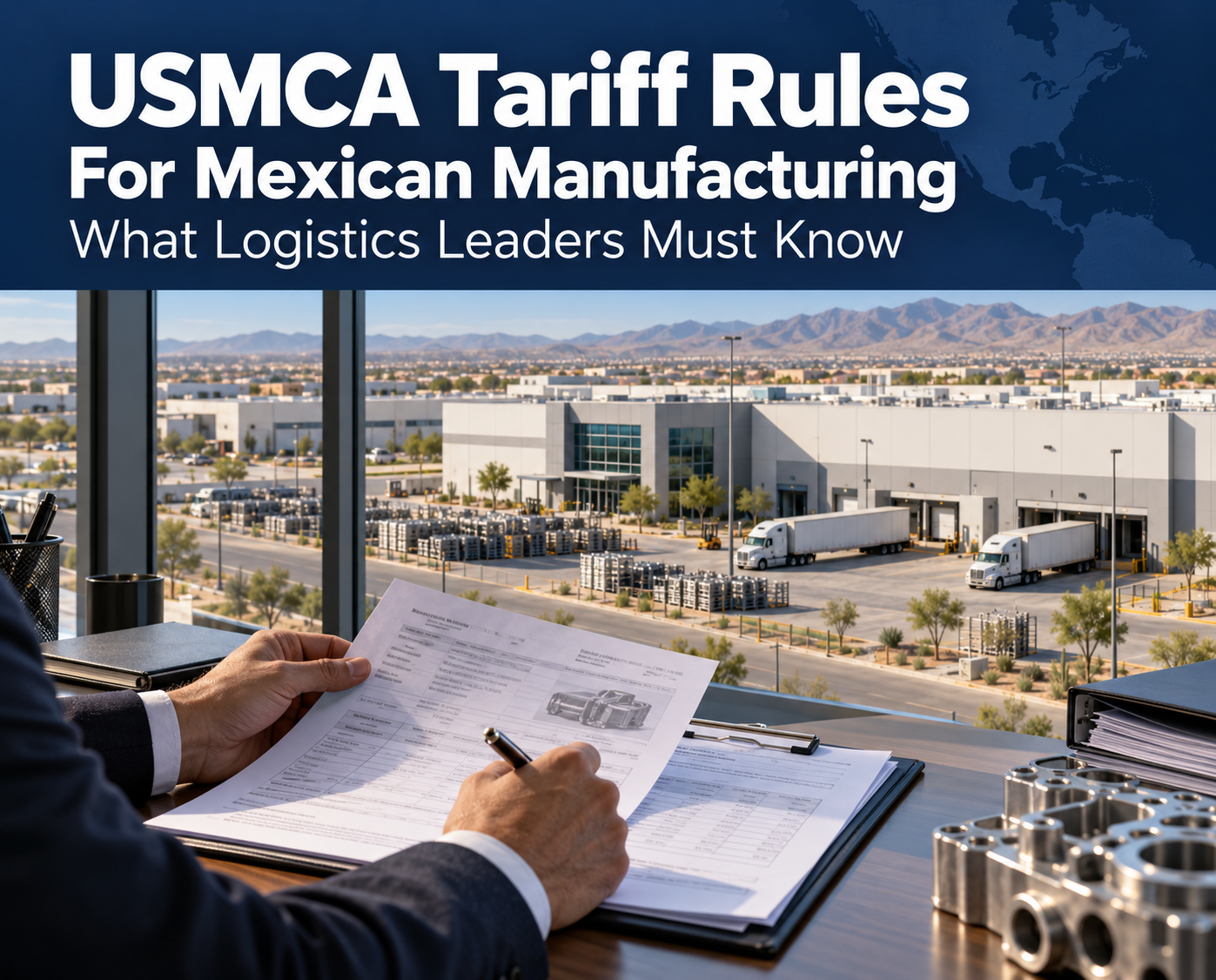
USMCA tariff rules in Mexico impact what qualifies for duty-free shipment. It is worth noting that these rules are routinely in flux.
As of September 2026, July 1st, a mandatory joint review has concluded with the U.S. declining to renew the agreement in its current form. This means that the situation is in flux. Currently, the Section 232 global surcharge of 10% has expired as of July 24th this year, to be replaced with tariffs of 10 to 12.5% on 60 economies tied to forced labor enforcement.
Because negotiations are active, current information is, let’s say, still being developed. That said, there are constants that we will get into in this article.
The bottom line is that no matter what the specifics of the regulatory environment are, mistakes like missing a rules-of-origin document will continue turning duty-free shipments into those facing tariff bills.
In this article, we take a look at how rules stand as things currently are and what the USMCA actually governs.
What the USMCA Actually Governs
First, it’s important to understand what the USMCA is and what it does.
The USMCA is a trade agreement between the United States, Mexico, and Canada. It replaced NAFTA in July of 2020 and covers everything from tariffs to rules of origin to labor standards and the dispute resolutions that follow.
The core benefit for manufacturers is that qualifying goods move between the three countries without duties. This avoids the standard most-favored-nation, or MFN, tariff rate, which can run up to 4% on non-qualifying goods.
There is, however, a built-in sunset clause that requires a joint review every six years. The first of these occurred in July of 2026, and as specified in the introduction, the particulars are still being sorted out.
Note that simply being a party to USMCA does not automatically qualify all shipments. Qualification ultimately still depends on meeting specific rules-of-origin criteria, which will be covered next.
How Tariff Classification Works Under USMCA
Tariff classification in U.S.-Mexico relations can be complex. Every product that enters the U.S. or Mexico is assigned an HTS (Harmonized Tariff Schedule) code. This is a numeric classification device that determines the duty rate.
HTS codes are usually six digits, though they may be extended to eight to ten digits at the country level for customs purposes. Misclassification, even by a single digit, will change the duty rate, or even worse, trigger an audit.
Rules of Origin Determine USMCA Eligibility
The HTS classification does not definitionally grant duty-free treatment. For that to follow, an item must also meet the USMCA rule of origin for its category.
There are two primary origin tests. One is wholly obtained. The product is produced within the USMCA region.
There is also a needed regional value content, which refers to a minimum percentage of the product value. As a concrete example, an automotive product will typically require higher RVC thresholds, sometimes as high as 75%. This reflects a stricter approach to auto sector rules compared to how things were under NAFTA.
Tariff shift rules may also apply. If a non-originating input within the HTS classification changes, an item can still qualify.
Certificates do not have to follow a strict template; however, they should include all of the required informational inputs. If they do not have all necessary data elements, the claim will be rejected.
Building USMCA Compliance Into Logistics-Side Operations
USMCA compliance logistics require the assignment of clear ownership for documentation. To this end, it helps to designate a specific compliance owner.
This can be an in-house trade compliance staff member, or even a licensed customs broker. This party will be responsible for verifying certificates of origin prior to shipment.
It’s a relatively straightforward task, but one that can serve to eliminate the risk of customs holds. Many compliance failures are the result of unclear documentation processes.
It’s both an easy mistake to make, and arguably an even simpler one to correct. The key often lies in establishing task ownership.
Verify Supplier-Level Origin Data
The manufacturer’s own product can qualify; however, component suppliers must provide accurate origin data for the parts that have been supplied.
An easy way to do this is to require supplier certificates of origin as a mandatory element of supplier onboarding. The alternative is to do so when a customs question has arisen, an option, to be sure, but one that can result in delays, fees, and other compliance issues, depending on the situation.
Audit Classification and Origin Claims Regularly
Internal audits carried out periodically can help with HTS classifications and origin claims. Misclassifications often are not caught until a CBP exam comes up, after which point the damage is often already done.
Self-identified errors, when fixed proactively, will still carry penalties, but they are typically lower than they would be if the mistake was discovered by CBP.
Track Tariff and Trade Policy Changes Actively
We described already the way that trade policy changes routinely. The events of 2026 alone testify to the importance of staying abreast of developments.
Assigning a compliance staff member, a customs broker, or a trade counsel to monitor updates as they occur will keep you informed and allow you to make pivots where necessary.
USMCA for Manufacturers: Sector-Specific Considerations
USMCA for manufacturers can involve a variety of considerations that are largely dependent on the industry.
For example, automotive and auto parts feature stricter regional value content requirements compared to other goods. USMCA-qualifying vehicles and parts can still face tariffs because of their metal content, or other tariff-related actions that operate independent of the USMCA.
Steel and Aluminum-Heavy Products
Section 232 steel and aluminum tariffs are dependent upon the metal composition as well as the country of origin. In these cases, judgments exist independent of whether or not the product would otherwise qualify under USMCA.
This can be a fairly common point of confusion and indeed frustration. USMCA qualification alone does not completely protect products from tariff actions when other factors, like metal content, also have weight.
Electronics and General Manufactured Goods
Electronic and general manufactured goods tend to follow the same regional value content or tariff shift rules. However, they do have less in terms of the heightened auto sector thresholds.
Components sourced outside of North America, for example, the always-common Chinese subcomponents, will often create origin disqualifications.
Customs Compliance USMCA: What Happens When Something Goes Wrong?
Customs compliance USMCA issues are common, even when every effort has been made to avoid them.
There are a range of consequences for compliance failures that can include everything from denial of the USMCA claim, resulting in duties owed at the standard rate, to penalties for negligent or fraudulent misclassification.
In that case, increased audit scrutiny for future shipments is a common next step.
It’s always a good idea to retain supporting origin documentation, including supplier certificates, bills of material, production records, and more for at least five years. This matches the CBP standard for record retention requirements and is just generally useful to have at the operational level.
What Logistics Leaders Should Watch Going Into Late 2026
The current state of affairs is still up in the air. USMCA does remain in force, but because the United States is declining to renew it as it is currently written, negotiations are still ongoing.
It’s a good idea to actively monitor activity during this period and be ready to pivot. The rules of today may not be fixed in years to come.
As the broader negotiation resolves, the fundamentals covered in this article are likely to remain evergreen. Accurate classification, solid documentation processes, and supplier-level verification are always useful.
Vector Trade Office is a 4PL partner with a leadership group that has decades of experience in cross-border logistics across the U.S.-Mexico corridor. Click here for more information.