Supply chains are changing. Mexico has recently jumped six spots on the Kearney 2026 FDI Confidence Index. Where it was once 25th, it’s now 19th, representing the single-year gains globally, comparable only to those of growth in Singapore.
In 2025, Mexico closed with a record of $40.8 billion in FDI. In Q1 of 2026, it’s done $23.6 billion. Nearshoring activity accounts for 58% of those figures. Deloitte has found that 62% of American companies are either actively pursuing relocation to Mexico or at least considering it.
Here’s the bottom line: relocating products closer to the border solves some problems, but not all of them. Nearshoring does close a distance problem, but if visibility issues remain, inefficiencies will endure.
Vector Trade Office is a concierge-level 4PL strategic partner that offers true insight to the companies that work with it. In this article, we look at the cost of reactive logistics in the context of nearshoring blind spots. Read on to learn more about the importance of Mexico supply chain visibility.
The Cost of Reactive Logistics
Despite the technology of our day, many companies run their cross-border logistics through surprisingly manual processes. Phone calls and manual status checks may work well on a small scale but break in the face of volume.
First of all, border crossing times are not stable. A truck that is historically cleared in one hour could be held up for 10 or more hours during a period when the CBP is reassigning officers toward enforcement priorities beyond the border itself.
The consequences of these delays are significant, particularly in the face of the fact that 15% of all U.S. imports come from Mexico. This means that even small delays on a truck-by-truck basis can have a massive impact at the scale of tens of thousands of crossings per day.
The McKinsey Research Center estimates that B2B handover friction results in up to $66 billion in annual expenses, resulting in more than 850 million hours of detention and dwell time in enterprise-level logistics.
Here’s the bottom line: when a company can’t see a shipment status until they are receiving a phone call about it, they’re always going to be reactive. It’s only through greater visibility that utility becomes possible.
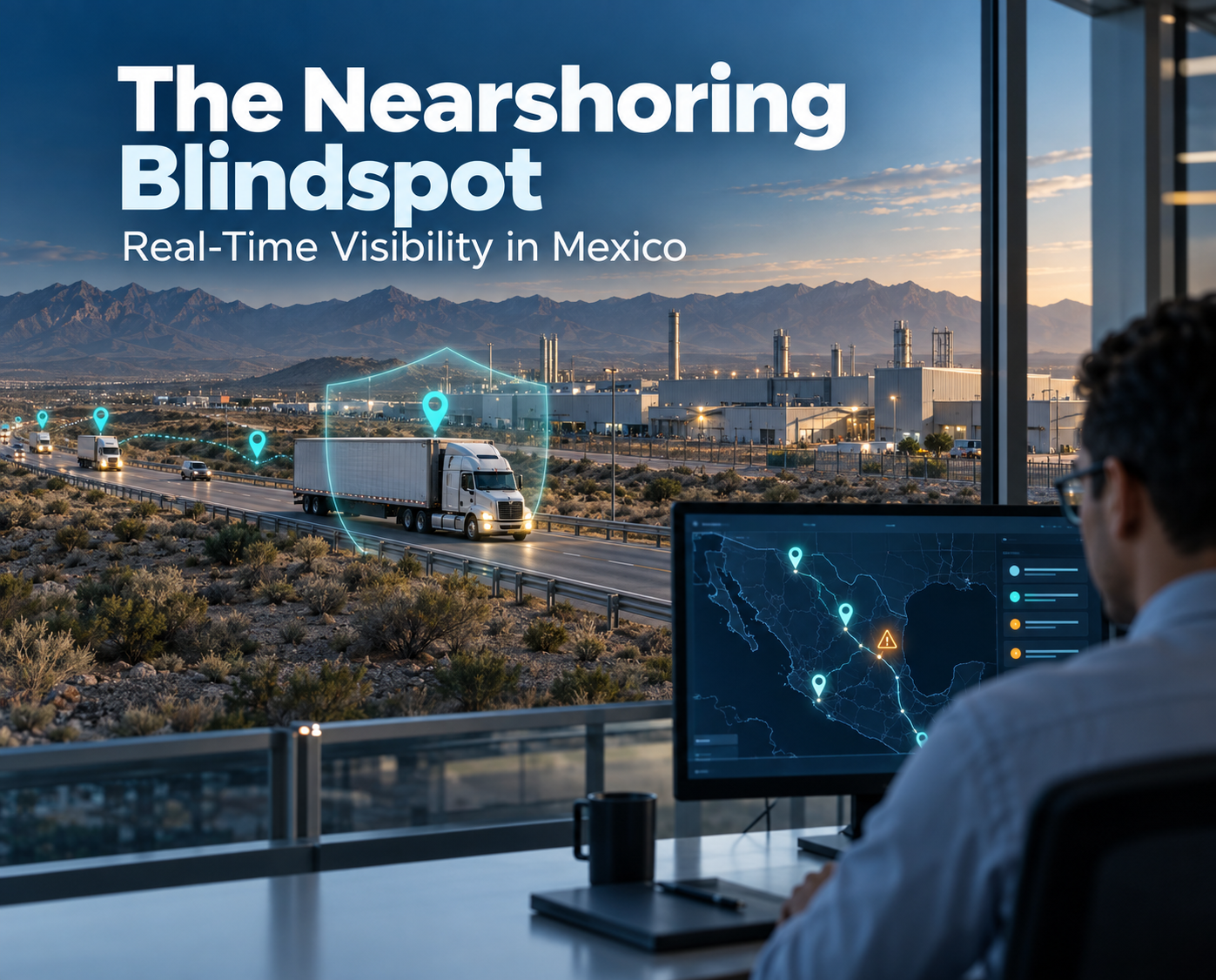
Real-Time Visibility as Strategic Armor
Supply chain visibility and international trade risk management hinge on better technology. There are a few components that are integral to the process:
- Automated milestone tracking. Status updates should fire on their own without the need for a phone call. The faster and more automated the update, the easier it is to respond appropriately.
- End-to-end data integration. Logistics has access to more information than has ever historically been possible. And yet, for many years since the so-called Digital Revolution, much of the data that software creates is held away where it can’t be used. Every app and system does create its own numbers, but they’re typically locked away in silos, preventing their implementation from people who need them the most.End-to-end integration results in a single source of truth that allows for the highest possible level of visibility.
- Anomaly detection. Anomaly detection occurs when a system flags a shipment that is running outside its normal pattern. For example, if a truck is sitting at a bridge longer than usual or missing an expected scan, the issue can be addressed in real time.
A company with real-time visibility is able to absorb disruption with greater ease and fix problems as they occur. This is something many businesses are already taking seriously.
The supply chain visibility software market is projected to grow at 13% annually and is currently already valued at $3.5 billion. Companies with mature tech adoption report higher returns on their software investments than other brands.
Mexico freight tracking can be managed more effectively than ever with better software. But true adoption does take deliberate effort.
As is the case with many business technology considerations, the bottleneck is not what is available or even the price of high-quality solutions. More often than not, it’s the knowledge of what it takes to coordinate information effectively.
Executive Audit Checklist
If you are concerned about the capabilities of a potential logistics partner, there are several questions you can ask to audit their readiness in the context of shedding light on blind spots. Any VP of logistics or CFO should be able to answer these prompts immediately without hesitation. They include the following:
- Can you name the exact point of entry and current status of your highest-value shipment without making any phone calls?
- Do you get automatic alerts when a shipment’s dwell time at the border exceeds the normal range, or do you only find out in the face of a missed delivery?
- Is your customs documentation being tracked and validated before the truck reaches the bridge or after?
- If the USMCA review changes a rule-of-origin requirement mid-year, how long does it take for your team to identify the affected shipment?
- Do you have a single source of truth for shipment status, or does that answer depend on which system is being checked in a given moment?
These questions needn’t necessarily make or break your partnership decisions, but they are absolutely relevant to the type of experience a logistics partner is able to provide. A no to two or more of these concerns indicates genuine blind spots that can create delays, costs, and many ongoing headaches.
Conclusion
Nearshoring has been a positive thing for imports across the Mexico and United States corridor. However, the distance problem that it solves does not automatically also relieve visibility issues. True efficiency requires the ability to fully comprehend bottlenecks and react to them in real time.
Real-time visibility amplifies by a significant extent the benefits already present in nearshoring. The result is shorter lead times without trading predictability.
Are you interested in learning more? If so, connect with Vector Trade Office for a supply chain audit.