
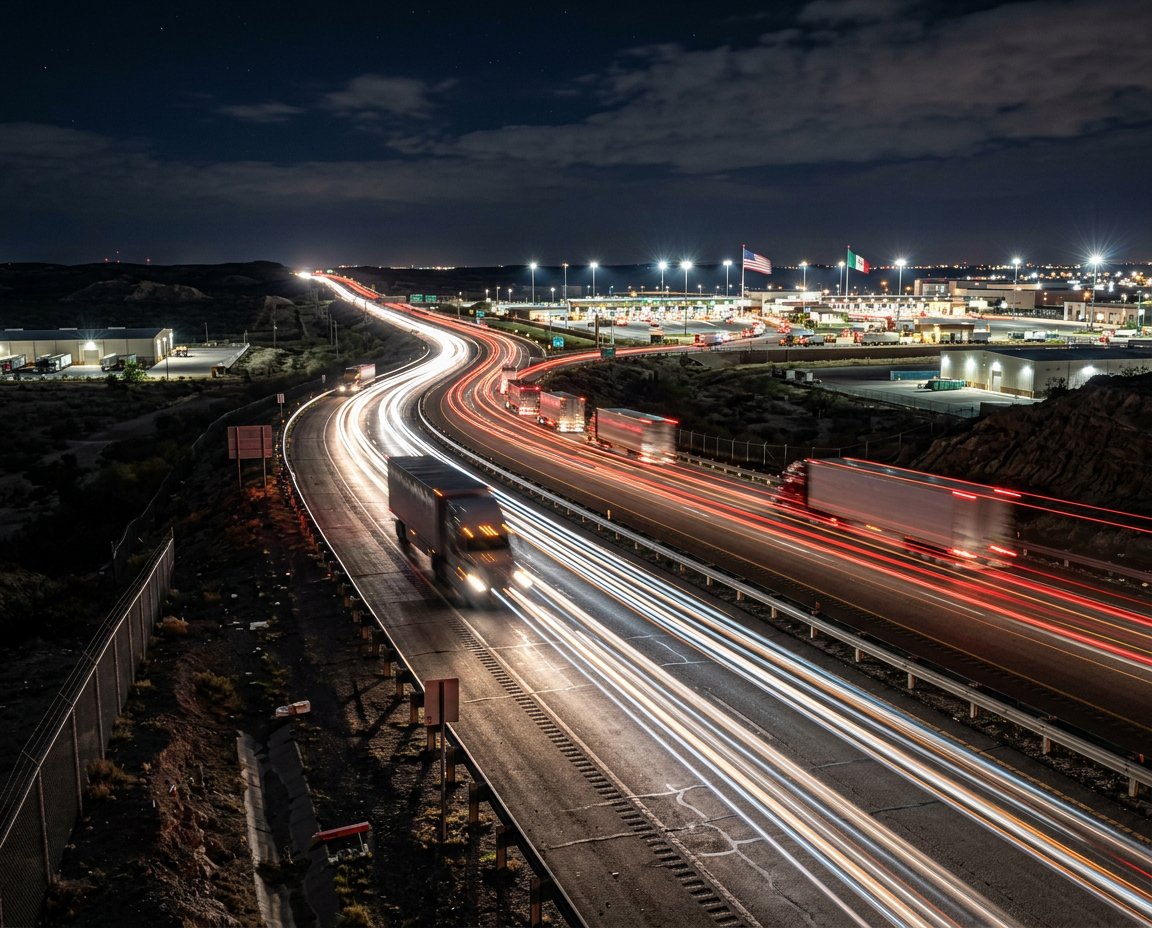
When a truck winds up sitting at Laredo or Otay Mesa for hours that extend well past the free allotment, charges rapidly accumulate.
Detention fees are applied to a shipper when a truck is held beyond the agreed amount of time for loading, unloading, or customs clearance. To reduce detention fees cross-border, firms need to take a targeted, deliberate approach.
This article is focused specifically on the U.S.-Mexico corridor and includes information on handling customs, dual inspections, drayage handoffs, and more. In this article, we take a look at what causes detention fees in the first place and how you can reduce them.
What Are Detention Fees in Cross-Border Trucking?
As mentioned in the introduction, detention fees in U.S.-Mexico trucking apply to trucks that have been delayed at a facility.
There is a distinction between detention, in which the delay occurs at a loading facility, and demurrage, in which a container is held at a port or rail yard.
Free time refers to the allotted lag period granted within contracts for loading and unloading. Typically, one to two hours is common.
Detention fees can play out at the scale of $50 to $100 per truck, though the exact number will vary based on the carrier and the lane itself.
Cross-border loads are particularly exposed because there are extra steps involved: a drayage carrier at the border, customs clearance, and a long-haul carrier on the other side. Each handoff can result in detention.
This can result in fees that add up very quickly, particularly on high-volume lanes like Laredo to Monterrey, El Paso to Juarez, or Otay Mesa to Tijuana.
Why Detention Fees Are Particularly Common on the U.S.-Mexico Border
The U.S.-Mexico border operates on a two-stage clearance process: Mexican export clearance and U.S. import clearance, or the reverse if going northbound.
Common holdups can vary from including everything from missing or incorrect commercial invoice data, HTS code mismatches, incomplete NAFTA/USMCA certification, or even random CBP exams.
The problem is that there are many small details that contribute to cross-border transit. Even a small mistake can result in a multi-hour hold.
Drayage and Cross-Dock Handoffs
Most cross-border freight changes trucks at the border. This is because Mexican carriers historically can’t operate deep into the U.S. and vice versa.
Each handoff point can result in hours’ worth of delays. When there are yard congestions at major crossings, it doesn’t change the time limit in the contract. Idling trucks can still run up a fee.
Warehouse and Dock Scheduling Failures
Many detention charges begin at the point of origin. When there’s no appointment slot or an understaffed dock crew, or the shipment arrives before the dock is ready, it throws every ensuing stage of the process off.
First-come, first-served practices are very common on both sides of the border, meaning if you don’t get off to a timely start, everything else can fall quickly behind.
How to Avoid Detention Fees
While detention fees can accrue quickly, there are things you can do to reduce their impact. In the next few sections, we look at concrete steps to take that will avoid errors and accelerate cross-border logistics.
Submit Complete Customs Paperwork Before the Truck Arrives
Pre-clearance involves submitting the pedimento and U.S. entry documents approximately 24 to 48 hours prior to arrival. This accelerates the clearance process by handling some of the steps while the truck is still en route.
You should also take careful note of the documents that must be accurate and complete. This will include the commercial invoice, the packing list, the certificate of origin, the bill of lading, and the NAFTA/USMCA qualification documentation.
Remember that little errors, including things as simple as a missing signature, can heavily influence the process, causing delays that can easily result in hundreds or thousands of dollars in fines.
Enroll in Trusted Trader and FAST Lane Programs
CTPAT, or Customs Trade Partnership Against Terrorism, and FAST, Free and Secure Trade, are U.S.-Mexico border programs that allow proven carriers and shippers to use fast lanes that involve fewer inspections.
Enrollment does require security audits as well as a lengthy compliance documentation process, but the front-end effort can save significant amounts of time and money later down the road.
Use Dock Scheduling and Appointment Software
Appointment-based receiving, driven by software that assigns arrival windows and tracks dwell time automatically, can significantly accelerate the process.
Visibility into real-time truck location, as facilitated by ELD or GPS tracking, also allows warehouses to adjust their staffing prior to a truck’s arrival to reduce wait time at the dock.
Negotiate Clear Detention Terms in the Carrier Contract
Many detention disputes happen because free time and hourly rates were never defined clearly in the contract.
Specify in writing, per lane, how much free time is allowed and what hourly detention rate will ensue after free time has finished. Clearer terms will reduce billing disputes and potentially diminish your liability for fees.
Build in Buffer Capacity at Border Crossings
Using a dedicated drayage provider with equipment staged at the border can help reduce handoff delays.
Cross-docking or bonded warehouses will use the border as a way to decouple the wait for the next truck and improve communication between all parties in the chain.
Finally, improving communication through centralized messaging systems such as WhatsApp or other dedicated portals can help connect all parties onto a single interface.
Often, detention time is the product of waiting on someone else. Process-driven communication strategies can alleviate some of this.
What to Do When You’re Already Facing a Detention Charge
This is all great advice for future activity. What if you already have a big pile of detention charges?
It is worth noting that you can potentially dispute detention invoices by requesting the carrier’s arrival and departure timestamps and comparing them against the free-time agreement to verify who is at fault.
It’s always a good idea to document delays with timestamped photographs, driver log-ins, and more as a standard practice going forward.
That said, developing a strong foundation for timely and efficient border navigation is ultimately going to be the best way to avoid detention fees going forward.
Vector Trade Office is a 4PL partner with a leadership team that has extensive experience in cross-border logistics. Schedule a discovery call to learn more about how we can help you reduce detention fees.