
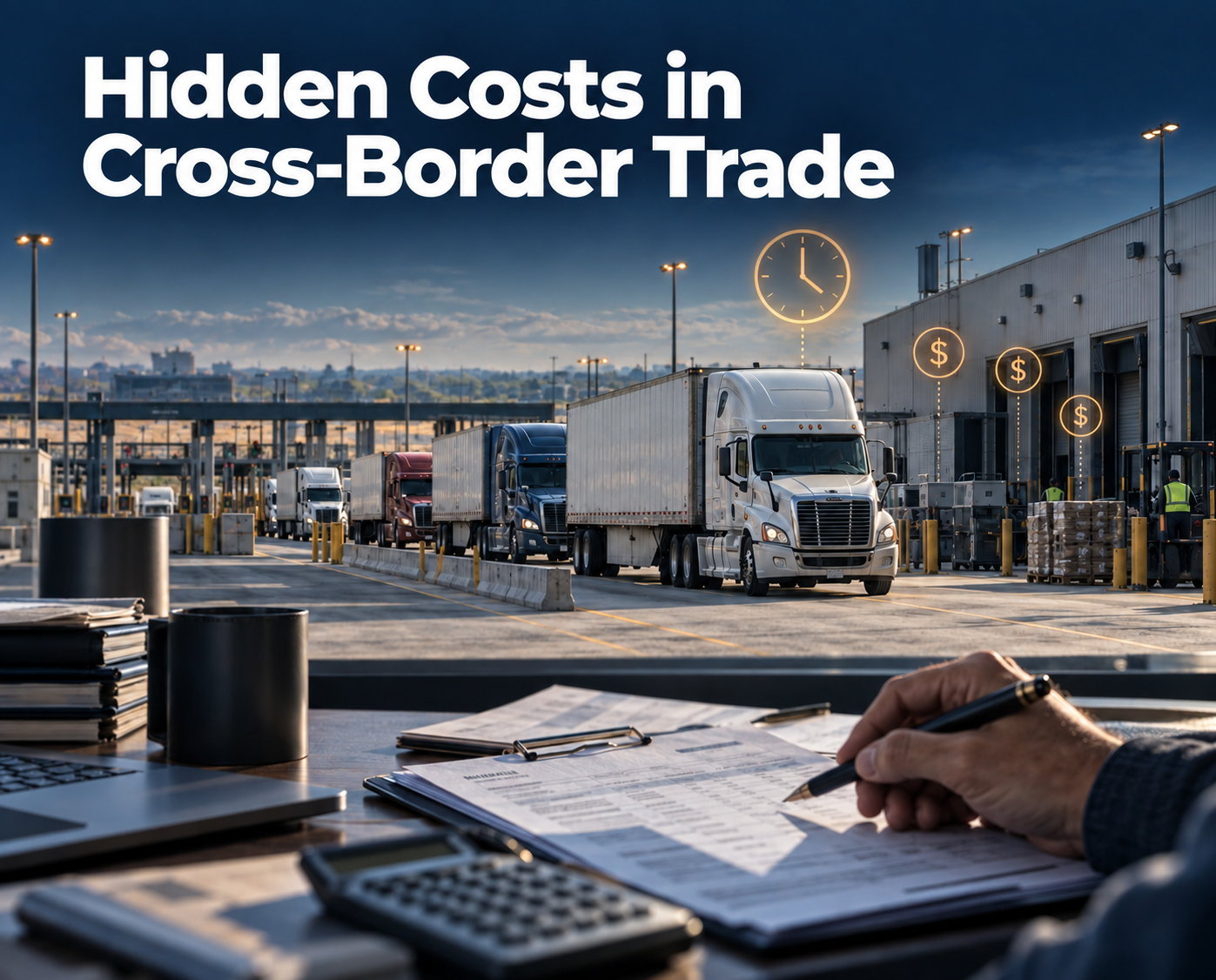
In the world of cross-border trade, there are obvious costs that everyone is aware of. This includes carrier rates, tariffs, and more. While these expenses can be considerable, they are also accounted for within the business model. It’s in unexpected costs that profit erosion actually takes place.
Margin erosion refers to the slow but decisive process of having profits get eaten away by small recurring costs. These expenses can be harder to account for because they take place gradually over time and do not show up as a single large line item.
Cross-border logistics costs don’t need to be mysterious. With knowledge comes power. In this article, we take a comprehensive look at supply chain cost reduction processes that can help businesses improve their margins.
Border Idle Time and Demurrage
Customs demurrage fees refer to shipping or terminal charges in which a container sits at a port or border facility for longer than the allotted free time. Free time allotments are variable but generally take the form of three- to seven-day spans.
Essentially, demurrage is a late fee for not moving a container fast enough. Unfortunately, it also comes with a companion fee in the form of detention. Once a container has left the terminal but has yet to be returned empty by the deadline, a detention fee takes place. This is the cost associated with holding up the physical container for longer than is intended.
Demurrage rates vary, but in 2026 could be as high as $300 per container per day. This rate will escalate the longer the container sits. For individual containers, the expense is not crippling, but at scale it can become significant quickly.
A 100-container shipment, for example, could result in a $60,000 demurrage fee. The U.S. Federal Maritime Commission data has tracked over $15 billion in demurrage and detention billing between April of 2020 and March of 2025. These fees indicate that demurrage is a genuine systemic cost category, not an edge case.
It is a good idea to budget for some demurrage and detention fees. Generally, setting aside 1–2% of the total freight value for potential demurrage is a good rule of thumb.
It’s important to note that many things can cause these circumstances to occur. For example, paperwork delays, payment holds on duties, random customs exams, and so on.
Real-time tracking can significantly reduce the risk of demurrage fees, but even within a well-oiled system, they should be accounted for as a possibility.
Manual Error
Trade compliance optimization helps reduce the risk of manual error.
Harmonized Tariff Schedule is the code system used by customs to identify what a product is. This informs the duty rate owed. It’s an expansive system with more than 17,000 potential codes. This adds a fairly intense level of complexity to compliance because choosing the wrong code, even if only by way of a typo, can mean paying a completely inaccurate tariff fee.
Manual entry errors can also result in customs holds. If a shipment is pulled aside for manual review due to something in the paperwork that doesn’t look right, mistakes can result in penalties and delays. The shipment will not be released until the issue is fixed, which can create costly problems.
Misclassification accounts for a significant portion of CBP penalty action. What’s more, businesses shown to have intentionally misclassified goods can owe literal millions in back duties and penalties.
Remember that audits can stretch and can look back into years of activity, meaning that mistakes that were undetected in the moment can still surface later.
It’s fair to say, of course, that most misclassification situations are genuine errors rather than the result of malicious activity. Regardless, the results are similar: delays, expenses, and regulatory problems.
Standardized documentation review and validation processes can help with trade compliance optimization, ensuring that issues are caught on the front end before they ever become a compliance problem.
Unoptimized Carrier Routing and LTL Inefficiencies
LTL, or less than truckload, refers to when a shipment does not fill the entire trailer. For context, a full trailer could include up to 15,000 pounds of cargo.
LTL is priced differently than a full truckload, in which the shipment fills the entire trailer. It’s less financially efficient, naturally, for a carrier to run at LTL. The solution is typically to seek consolidation. In other words, to combine shipments into a smaller number of fuller trucks. This lowers the effective cost per pound for everyone involved.
Routing is another costly inefficiency. Routing guide leakage refers to situations in which a shipment is moved outside of a pre-negotiated carrier lane or pricing agreement. In other words, the volume discount can be lost in the process, sometimes without notice.
LTL rates sound small on the front end but become costly at scale, running to approximately 45 cents per pound. A poorly consolidated shipment can result in handling fees and additional charges that erode margins.
A variety of things can lead to this inefficiency, but a common cause is simply a lack of visibility. When there’s no centralized view of shipment volume, it’s easy for LTL shipments to go unnoticed. There are many situations when multiple LTL shipments that could have easily been consolidated pass by unobserved due to faulty systems.
Visibility concerning shipment volume makes it easier to identify consolidation opportunities.
Reactive Exception Handling
Exception handling in the world of logistics refers to how a company responds in the face of unexpected problems. Obviously, these can vary pretty dramatically from a missed pickup to a customs hold or even a mechanical breakdown.
Reactive exception handling means that the company finds out about the problem as the delay is being caused. In these scenarios, the most likely solution is also the most expensive one: emergency shipping.
Expedited freight involving dedicated trucks, team drivers, or even air freight can cost up to three times the expense of standard ground freight. Air freight itself can run up to six times higher than standard ocean or ground freight, which is why it’s typically used only in emergencies.
When a shipment falls behind schedule and no one catches it in time, the only remaining option is to seek the most expensive tier of shipment possible. Early detection often leaves the door open for more cost-efficient solutions like rerouting.
Diagnostic Phrase Framework
A logistics audit can help provide a robust diagnostic framework that genuinely catches many of the unexpected costs described up until this point. A solid three-step logistics audit consists of the following points:
- Pull the last 90 days of accessorial charges, including demurrage, detention, storage, and expedited freight fees from your carrier, and then total the costs. Many companies have never added these figures before and are surprised by how considerable they can be.
- Check your customs entries against your shipment paperwork during that same period. During this process, you look specifically for mismatches between invoice values, packing lists, and declared HTS codes. These red flags can directly result in CBP manual review. You’ll want to know if they are present in your current activity.
- Map your LTL shipments by destination and week. Look also for repeated partial shipments to the same region. Specifically, search for situations in which consolidation would have been possible with early detection.
If any of these checks turn up meaningful numbers, it means that you have a visibility problem that is quietly eroding your profits.
Conclusion
The nefarious thing about these leaks is that they happen gradually, not as a single major loss. It’s considerably easier to detect and react to a major one-time expense than it is to smaller ongoing ones.
However, catching this leakage as it occurs is an impactful way to improve margins.
Interested in learning more? Schedule a trade flow audit with Vector Trade Office. It’s a low-friction way to see how profit erosion can be addressed by the right strategic partner.