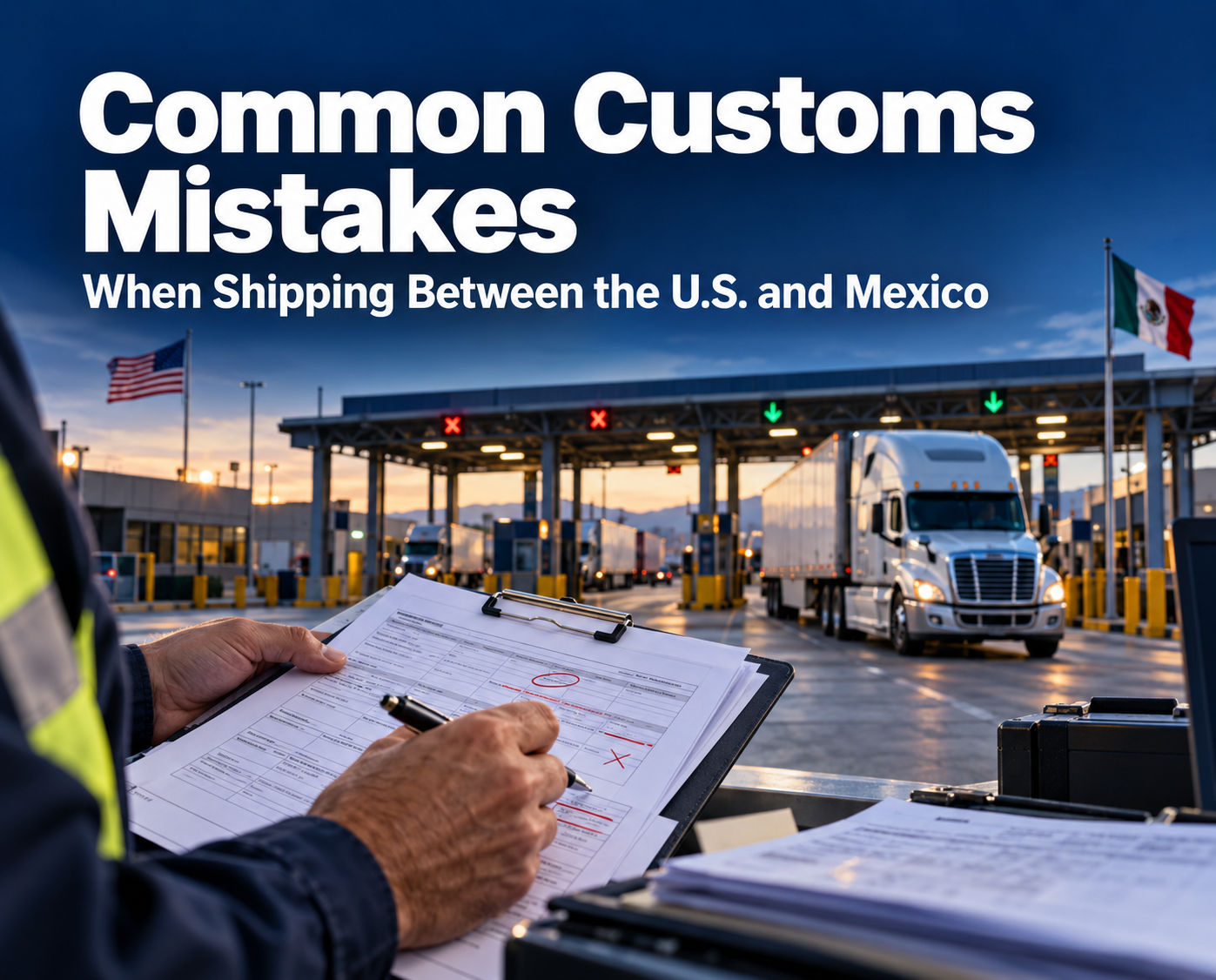
Daily, the U.S. Mexico border is flooded with trucks crossing. They carry parts, materials, and finished goods. The entire continent of North America depends on this freight corridor.
And yet, for manufacturers, even a single simple paperwork mistake can result in hours of delays and thousands of dollars in fees.
Not only is there a legitimate financial risk to mistakes, but there are downstream ramifications that are difficult to put a dollar value to: missed production windows, frustrated customers, a future filled with more fires to put out.
Fortunately, the majority of consequential customs errors are preventable. Typically, they come from a few common documentation gaps and coordination misfires.
In this article, we’ll take a look at some of the most common clearance mistakes and explain how your business can prevent delays.
Misclassifying Goods Under the Wrong Tariff Code
Products that cross the border are required to carry a tariff classification code. The United States uses a system known as the Harmonized Tariff Schedule. Mexico, meanwhile, has its own schedule based on a similar system.
If the code does not match the actual product, it will often trigger inspections, reassessed duties, and penalties.
These errors are typically not the result of intentional obstruction, but clerical mistakes, vague descriptions, or misunderstandings. Engineering updates, new material requirements, or repackaged components are all factors that can change classification codes.
It’s important to review your classification any time a product changes.
Inconsistent Commercial Invoices and Supporting Documents
Customs officials will take a look at the commercial invoice as well as the packing list. If the quantities, weights, values, or descriptions in the documentation don’t match the freight, the shipment will be flagged.
Sometimes these discrepancies are surprisingly small. Even a simple typo in a part number or an imprecisely rounded weight total is enough to stop a truck.
Through consistent review, these customs documentation errors are at least easy to prevent. To do so, however, someone should check every document against the others before a load is dispatched.
Missing or Incomplete Carta Porte Documentation
A Carta Porte complement for goods is required by Mexico for anything transported by truck within the country. This is a digital document that can be attached to an electronic invoice known as a CFDI.
Carta Porte details include information on the cargo, the route, the vehicle, and the driver. If any fields are missing or mismatched, the truck may be stopped at the border.
Mexican tax authorities will often also impose fines and holds for items moved without proper documentation.
Mishandling USMCA Certification of Origin
Goods that qualify under the United States-Mexico-Canada Agreement are able to cross the border with smaller or absent duties.
Shippers that intend to claim this benefit, however, need to provide a certification of origin with all of the necessary data elements accurately filled in.
Commonly, shippers will mistakenly claim preferential treatment without having confirmed that the goods actually meet the rules of origin. This can be a problem because if a later audit disqualifies the claim, back duties and penalties will be owed.
It’s important to keep supporting records for every certification you issue. Even years after a shipment has crossed the border, authorities can request that documentation and will often impose belated fees and fines if you are unable to supply it.
Overlooking Mexican Importer Requirements
U.S. shippers, unfortunately, sometimes overlook Mexican registration and labeling requirements.
Importers must generally be listed on Mexico’s official importer registry, known as Padrón de Importadores. Some products will also require sector-specific registration. If your customer or partner is missing a registration, that can result in a stalled shipment at the border.
Similarly, products that have been improperly labeled may represent trouble spots for southern shipments. Goods must comply with Mexican official standards, known as NOMs. This includes Spanish-language labeling rules.
If a shipment arrives without a compliant label, it can be held until the issue is corrected.
The solution is to confirm labeling requirements with your customs broker before the production runs are packed.
Poor Coordination Between Brokers and Carriers
Cross-border freight involves a lot of moving parts. Often, this will include a Mexican customs broker, a U.S. customs broker, and one or more carriers.
Every party handles a different part of the process, and because of that, information often becomes jumbled.
For example, U.S. Customs and Border Protection requires carriers to submit an electronic manifest prior to the arrival of trucks. If the manifest and the broker entry are in contradiction, the truck will wind up getting delayed. Late filings will typically result in a comparable problem.
How to Avoid Customs Errors in Cross-Border Shipping
It’s typical for mistakes to share a common root cause. Often, this is the byproduct of a lack of culpability. In other words, no single party owns the outcome from start to finish.
That’s often where we at Vector Trade Office are able to provide the most support. We are a 4PL cross-border governance team specialized in dealing with U.S.-to-Mexico manufacturers.
Our bilingual team embeds itself within your operations to oversee compliance, customs documentation, and carrier coordination.
Our goal is always to catch problems before your freight reaches the border.
If holds and fees are impacting your business, our team can review your current lanes and identify solutions.