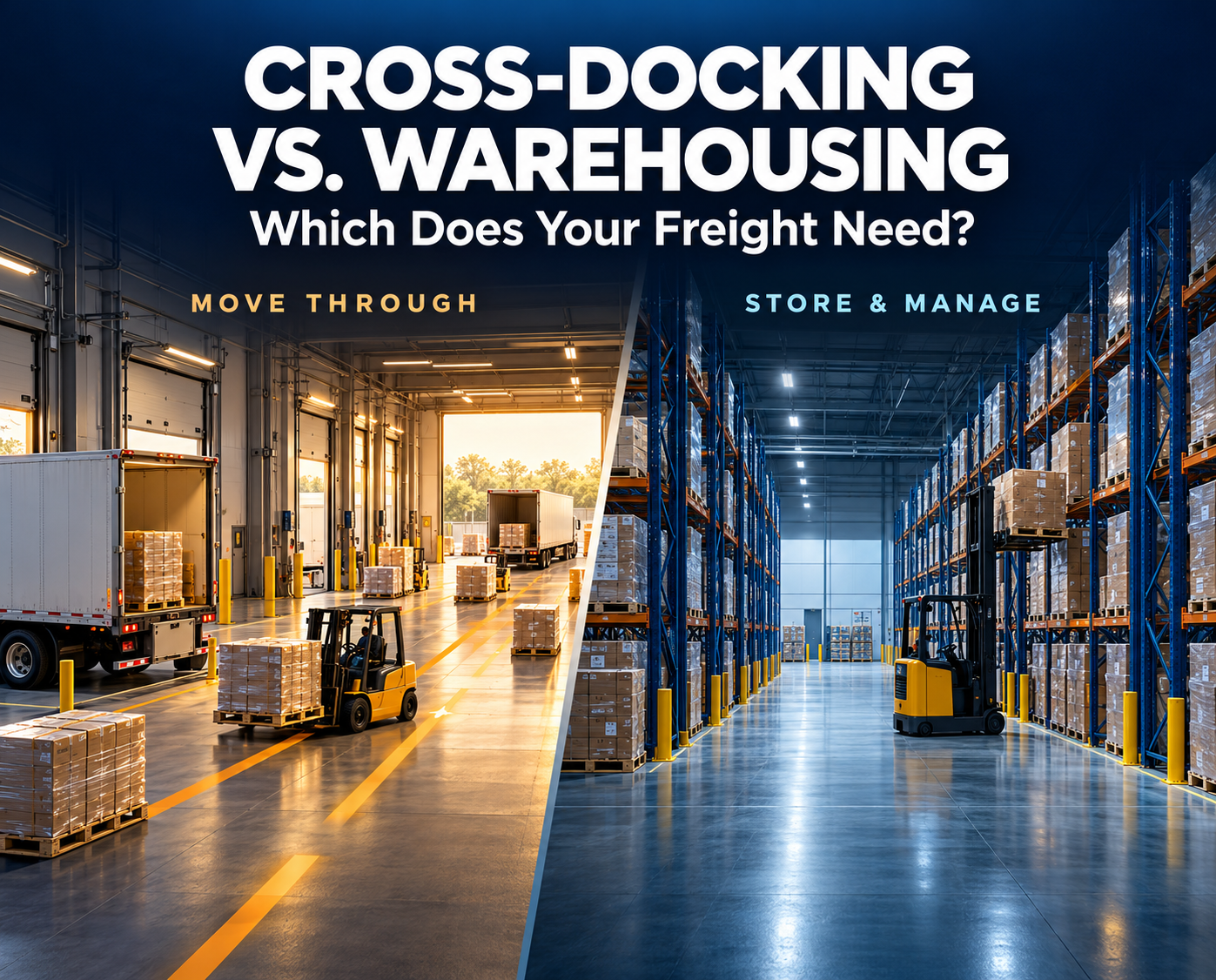
Growing shippers inevitably wind up in a growth-related predicament. What is the best way to move freight through the network? Common options, of course, include having it pass through quickly, or wait in storage until it is fully needed. We’re talking about the difference between cross-docking versus warehousing. This is an important question that can influence cost, speed, and inventory flexibility.
This choice will also decide how your supply chain performs when it comes to logistics at the U.S.-Mexico border. The wrong model will tie up your capital and possibly leave you vulnerable to delays. The right one will make you operationally agile and more reliable. In this article, we’ll look at how each option works, when and how to choose between them, and what their role in cross-border freight looks like.
What Is Cross-Docking?
First, let’s define our terms. Cross-docking refers to a process in which freight is unloaded, sorted, and then reloaded onto outbound trucks. Typically, this model involves little to no storage at all. Goods will only sit for several hours at most in the facility. Inbound shipments arrive, workers sort them based on where they’re going, and then move them to outbound trailers for prompt shipment.
This process is commonly applied in situations where several LTL shipments need to be consolidated into full truckloads. Often this approach will also be used to split full loads into smaller shipments that are meant for multiple destinations. This is, naturally enough, also an optimal model for time-sensitive and/or perishable goods.
Because this model definitionally involves less time sitting at a facility, deliveries are faster and handling costs are lower.
What Is Warehousing?
As the name suggests, warehousing involves storing inventory at a single location for a set period of time, often measured in days, weeks, or even months. This is the traditional model for receiving freight, storing it, and releasing it in response to orders or production schedules.
This is ideal for companies that need to maintain safety stock, prepare for seasonal fluctuations, and keep products close to customers, plants, or anywhere else that they need to be. It’s through this buffer that delivery commitments are projected.
Warehouses will often also include value-added components, including labeling, kitting, repackaging, and pick-and-pack fulfillment. In other words, the warehouse not only stores the inventory but facilitates the services required to make it move.
Cross-Docking vs. Warehousing: Key Differences
In both models, there is a strong emphasis on moving freight through a facility. However, each scenario solves a unique problem. Below, we’ve provided a table that compares options based on factors that matter most.
| Factor | Cross-Docking | Warehousing |
| Storage time | Hours, usually under 24 | Days, weeks, or months |
| Cost structure | Lower storage costs, higher coordination demands | Higher holding costs, more flexibility |
| Inventory risk | Low, since goods keep moving | Higher, due to capital tied up in stock |
| Speed | Fast transit to the final destination | Slower, but ready to ship on demand |
| Planning needs | Tight carrier scheduling and strong visibility | More tolerance for timing gaps |
| Best-fit freight | Predictable, high-volume, time-sensitive | Variable, seasonal, or production-critical |
As you can see, disruption is one of the biggest differentiating factors between these options. How each model handles delays or operational chaos can vary pretty substantially. Cross-docking typically is dependent on inbound and outbound carriers arriving on schedule. Warehousing, on the other hand, provides a better buffer when things do go wrong.
When Cross-Docking Makes Sense
When freight flows are steady and predictable, cross-docking can be an efficient and reliable model. High-volume lanes that experience consistent demand will make it easy for you to plan outbound loads even before the inbound trucks arrive. As mentioned previously, this is also the ideal model for time-sensitive or perishable items that genuinely do need to move quickly. In this scenario, even an hour saved in a facility is potentially relevant to the delivery time and/or shelf life.
Finally, there’s the flexibility that this method provides in the context of consolidating or splitting loads as needed. Combining LTL shipments into full truckloads will almost always lower costs per unit, all other things being equal.
That said, cross-docking does require a high level of both reliability and visibility when it comes to your shipment processes. A late inbound truck will result in delays for every subsequent outbound load depending on it. The downstream effect of even a single snag tends to be more punishing in this model.
When Warehousing Makes Sense
If demand is variable or seasonal, warehousing is often the better option. Manufacturers will often warehouse production inputs as a way of protecting their schedules. If a component comes into short supply, it can stop an entire production line.
Naturally, the more value-added elements that are required, the more sense a warehousing arrangement will make as well. If freight needs to be labeled, kitted, or handled in complex ways, warehouses are much better suited to administer those kinds of services.
And if you are operating in a supply chain that is vulnerable to disruption, warehousing arrangements do provide a buffer that will protect you where delivery commitments are concerned. That said, this method is more expensive, resulting in higher holding costs that tie more of your capital up into inventory.
Cross-Docking and Warehousing at the Mexico Border
At border hubs like Laredo, El Paso, and Otay Mesa, cross-docking and warehousing are both common methods of inventory management, playing key roles in how freight moves between the two countries.
At the border, both cross-docking and transloading are common, with freight frequently moving from Mexican equipment to U.S. equipment, or vice versa. It’s also very common to consolidate loads at border facilities before crossing. This is a good way to reduce costs.
Warehousing at the border is a little different. Inventory may be staged as a way of avoiding or absorbing crossing delays, inspections, and documentation problems. Bonded warehouses are another good option. Imported goods can be stored in U.S. bonded warehouses for up to five years without duties. Meanwhile, goods can travel to inland destinations before formal entry with in-bond movement.
For nearshoring manufacturers, the question is rarely which method to choose, but rather how to incorporate both as a way of maximizing efficiency and reducing risk without overcommitting capital.
The Hybrid Approach
As mentioned in the last section, it’s not at all uncommon for shippers to take pieces of both approaches. Fast-moving products can flow through cross-docks while slower products sit in the warehouse.
In all cases, it’s important to segment freight carefully. You can sort by velocity, demand patterns, and value to decide which model your materials require. In this framework, it’s important to regularly review your needs and make adjustments to ensure that maximum efficiency is maintained.
How to Decide Which Your Freight Needs
Start by asking a few direct questions about your operation:
- How predictable is demand for each product?
- How time-sensitive is the freight?
- What does a stockout or production stoppage cost your business?
- How reliable are your carriers and border crossings?
- How much visibility do you have across each handoff?
The answers depend on more than the facility itself. They reflect how your carriers, brokers, and providers work together across the whole supply chain.
Conclusion
Cross-docking trades storage for speed. Warehousing trades some speed for stability and flexibility. Most cross-border operations benefit from a deliberate mix of both rather than a default choice.
Designing that mix is a question of supply chain architecture. Vector Trade Office works as an extension of your management team to structure facilities, carriers, and handoffs around your business goals.
If you want to find the right balance for your freight, book a short discovery call with our team.